


As contactless payments and accurate inventory management become increasingly important in today’s fast-paced market, near-field communication (NFC) is a must-have technology.
NFC is a short-range wireless technology that enables tap-to-pay interactions when a phone, card, or reader is within a few centimeters. For retailers, it’s important to offer contactless payments as consumers increasingly adopt them.
In 2025, Capital One reported that 69% of US adults used a digital wallet at least once in the previous 30 days, while 32% of global point-of-sale (POS) transactions were facilitated by one.
Ahead, learn what NFC is, how it works, and how retailers are using it in 2026.
What is near-field communication?
Near-field communication is a short-range, contactless technology that requires a distance of 4 centimeters (1.5 inches) or less to establish a connection. It operates at 13.56 megahertz (MHz) and is designed for simple, fast interactions such as payments, access, and sharing small bits of information.
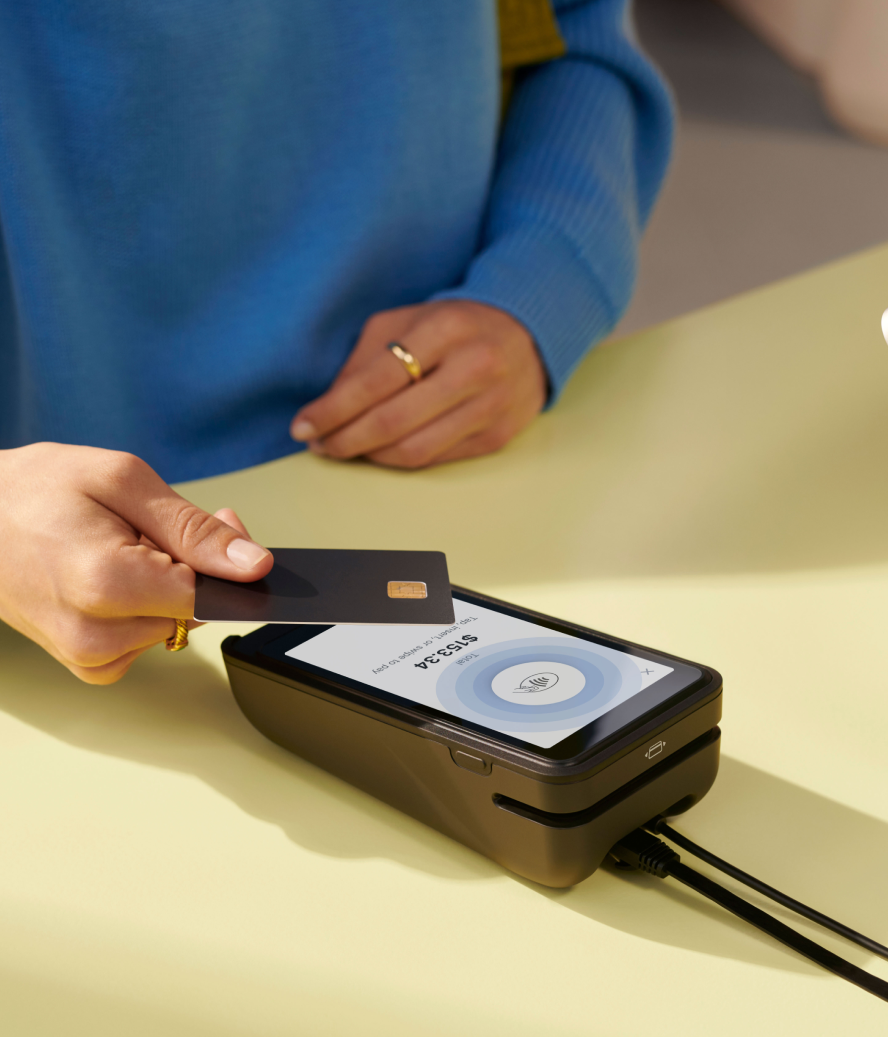
For shoppers, NFC is the “tap” in tap to pay. Consumers simply hold a smartphone, smartwatch, or contactless card close to a payment terminal to complete a purchase. Mobile wallets like Apple Pay, Google Pay, and Samsung Pay use NFC to transmit payment credentials without sharing the actual card number with the merchant.
Unlike Bluetooth or Wi-Fi, which are designed for long-range connectivity and continuous device communication, NFC works only when devices are practically touching. The short-range feature ensures that transactions occur only when you intentionally tap, making it hard for hackers to intercept your signal from a distance.
When you pay with a mobile wallet, your card number is never shared with the store. Mobile wallet providers use payment tokenization to swap your real info for a device token. For every purchase, the phone generates a unique cryptogram, similar to a one-time security code, so even if someone intercepted the data, it would be useless for future transactions.
NFC meaning for retail businesses
Tap payments are the secret sauce behind faster checkouts, lower hardware costs, and real-time inventory visibility. They’re also what consumers expect from retailers. Mastercard reports that contactless payments accounted for more than 75% of transactions in its network in 2025, indicating the trend is here to stay.
The move to NFC payments has plenty of benefits for retailers, allowing them to do the following:
Accelerate checkout lines
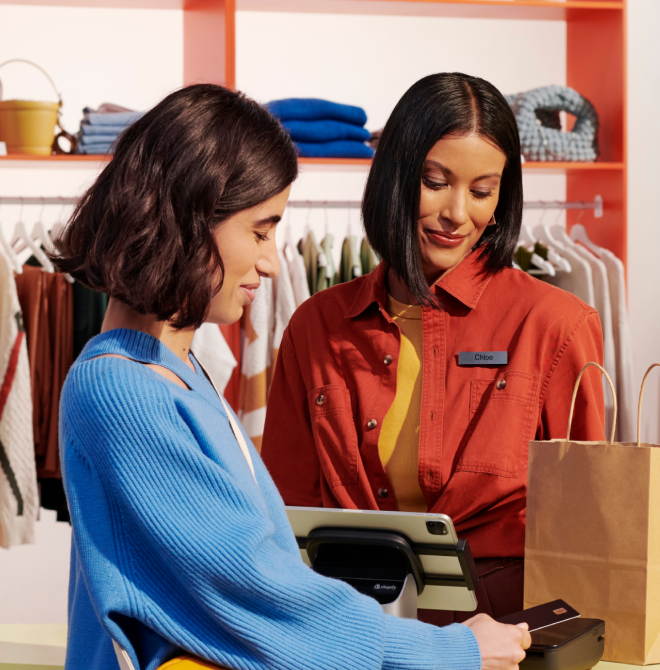
NFC mobile payments happen in a split second. They don’t require precise alignment or customer understanding. Associates can process these transactions on the sales floor, in fitting areas, or at curbside handoff points.
Decouple from clunky hardware
Tap-to-phone acceptance has grown 200% year over year as of March 2025, according to Visa. For stores with a small footprint, you no longer need a desk or traditional checkout counter—instead, you can use a mobile device. This means faster location rollouts, less time training staff, and event setups with zero hardware lead time.
Easily track inventory with higher accuracy
NFC tags allow retailers to create automated inventory management systems. They’re also useful for complying with regulations such as the digital product passports (DPP). A single NFC tap can direct a customer to a blockchain-linked product record or a dynamic URL for actions such as reordering, while providing the brand with item-level scan data that supports supply‑chain traceability and helps identify potential gray‑market diversion—provided the supporting back-end systems are in place.

How does NFC work?
NFC isn’t a new technology. It’s essentially an advancement of RFID (radio frequency identification) technology, which has been used for decades. If you’ve ever used a key card to enter a hotel room or office building, you’re already familiar with its principles.
NFC works through near-field inductive coupling. An NFC reader (like a store’s payment terminal) constantly generates a 13.56 megahertz electromagnetic field, and the moment a phone’s coil antenna enters that space, it catches the energy needed to start exchanging data. The setup allows the reader to instantly power passive tags, such as those in transit cards or smart posters, so that they can transmit data without a battery.
NFC typically operates in three modes:
- Reader/writer mode. A phone or terminal reads data from and writes data to NFC tags.
- Peer-to-peer mode. Two NFC devices exchange small amounts of data directly.
- Card emulation mode. A phone or wearable device emulates a contactless card, enabling it to work with existing NFC readers.
The small operating range is a feature. NFC technology creates a firewall that prevents eavesdropping on your sign and accidental payments from across the room.
EMV vs. NFC
Payment cards today are often dual-interface, meaning they combine two technologies into one piece of plastic. Here is how they work at the point of sale:
- EMV chip. A physical chip used for tapping or dipping (inserting a card). It stands for “Europay, Mastercard, and Visa,” and is the global security standard for chip-based payments.
- NFC antenna. The wire inside the card that enables wireless communication with a payment terminal. NFC allows EMV data to be transferred from your card to the terminal without a physical connection.

Whether a shopper dips or taps an EMV device, they are protected by EMV security controls. When they pay, the card creates a unique, one-time code. Even if a hacker sniffed the transaction, they couldn’t reuse that info to make another purchase later.
Mobile wallets add an extra layer by using a surrogate number instead of your actual PAN (primary account number), keeping your real card details hidden from the merchant’s system.
EMV and NFC work together to process card payments. EMV sets the security rules, and NFC is the wireless way your card or phone talks to the terminal. When you tap (contactless EMV over NFC), checkout is typically faster than when you insert the card.
Since NFC only requires a connected device or card to hover above a reader, you can take payments quickly and move through lines efficiently. You likely won’t need as many staff working at your checkout.
NFC retail applications
In retail businesses, NFC applications include the following:
Accepting payments
Accepting NFC payments is flexible and easy to scale. As long as a business has contactless-capable hardware or a supported phone-based option, customers can pay with contactless cards, mobile wallets, and other tap-enabled devices.
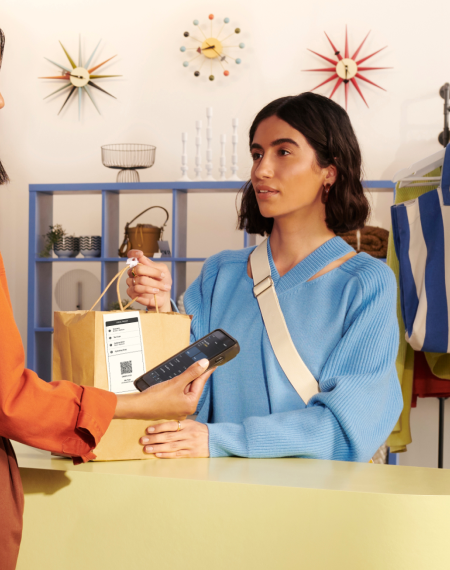
During periods of growth and busy times, NFC can make checkout a breeze for shoppers. Solutions like Tap to Pay on iPhone let businesses accept in-person contactless payments with an iPhone, turning your device into a mobile POS. Low cost and low maintenance, these devices are ideal for pop-ups and great for busting long checkout lines. Use them to quickly equip staff without rolling out additional terminals.

Inventory management
Retailers that need to process and manage high inventory volumes will benefit from using NFC tracking.
You can purchase pre-encoded NFC tags with sequential numbers and link them to inventory items using a QR inventory application. Use your inventory app to link each NFC tag to a specific item. Then, staff can use any NFC‑enabled smartphone to tap the tags and track those items.
Retailers use NFC for various inventory management processes:
- Tag at receiving. When a shipment arrives, staff affix an NFC tag to each sellable unit and associate that tag’s unique ID with the product’s SKU in the inventory app.
- Putaway. Staff tap the tag to assign a location, such as a backroom bin, shelf, or display.
- Cycle counts. Staff can walk the floor and tap items to confirm on-hand quantities and flag any missing or damaged items.
- Transfers and returns. On a transfer or return, staff can tap to change status and keep logs tied to the item’s tag ID.
NFC makes inventory scanning more convenient in many workflows, since staff don’t have to line up a visible barcode for each scan.
💡 PRO TIP:Shopify POS includes tools to help you manage inventory across multiple store locations, your online store, and your warehouse. Forecast demand, set low-stock alerts, create purchase orders, identify which items are selling or sitting on shelves, count inventory, and more.
NFC tags
NFC tags can enhance the in-store customer experience and encourage consumers to engage with your brand beyond your physical location.
In addition to accepting in-store payments, Alexa Allamano, owner of the jewelry store Foamy Wader, uses NFC tags to market her business and help convert window shoppers into buyers.
“We use NFC for accepting payments in-store, collecting new email subscribers, and directing window shoppers to complete their order online,” says Alexa.
Use cases for retailers span far and wide. Some of the most common types are:
- Product info on shelves and packaging. Instant tap access to sizing guides, ingredient data, and care instructions.
- Window to online conversions. Direct links from window displays to SKU-specific pages for instant checkout.
- Cross-selling and bundles. Tapping hero products to trigger “complete the look” bundles or accessory recommendations.
- Post-purchase engagement. One-tap warranty registration, setup tutorials, and simple reordering online.
- Loyalty and personalized offers. Swift enrollment in loyalty programs and delivery of targeted promotions for members and VIPs.
NFC tags have also become more important as the EU’s Digital Product Passports begin to roll out, prompting companies to provide accessible data on a product’s life cycle and sustainability. The NFC Forum positions NFC as a strong data carrier for DPP-style transparency and requirements.
Benefits of near-field communication for payments
The use of NFC for payments is on the rise. In fact, the near-field communication market is expected to reach nearly $37.3 billion in 2026, with a compound annual growth rate (CAGR) of 15.22% until 2031. Here are some of the benefits driving this expansion:
Security
NFC transactions are considered secure because they rely on proximity. NFC signals use a specific RFID frequency (13.56 megahertz) and work only when the chips are very close together.
Peer-reviewed research shows that the underlying electromagnetic near-field interaction decays rapidly with distance. So, the effective field for communication dissipates quickly beyond the intended tap range. Interception from across the room is impractical in normal retail situations—a hacker would need to be nearby and use specialized equipment to succeed.
Smartphone security protocols make NFC payments even safer for consumers. In addition to protecting sensitive personal data through tokenization, smartphone e-wallets provide other layers of security, including passwords and biometric authentication.
Speed
Checkout speed is a major driver of NFC adoption. In 2025, 78% of consumers said they want fast and convenient payment options.
With NFC tap to pay, transactions are completed within seconds. Customers tap a phone, watch, or contactless card, and the payment terminal sends the transaction for approval.
My Supplement Store uses near-field communication across its physical retail stores to improve customer experience, speed up checkout, and reduce staffing.
“We have terminals that allow for contactless payment on anything they purchase. It makes their shopping experience quick, painless, and allows us to work with more customers in the store with fewer staff,” says marketing manager Jeff Moriarty.
Similarly, Alexa of Foamy Wader likes to give her customers more payment methods and speedier processing.
“It’s only a matter of seconds, but the speed of NFC payments is noticeable compared to credit card swiping and chip dipping. NFC also allows shoppers to leave home without their wallet, which has come in handy for joggers and dog walkers to use their phones to make impulse purchases,” says Alexa.
Unlike chip-insert payments, tap to pay is a single gesture: you tap and hold near the reader. In many regions, a PIN may be required above certain tap limits, but customers can complete everyday purchases without inserting a card.
💡 PRO TIP: Shopify POS offers a fully customizable checkout experience. Create shortcuts to keep your most-used apps, promotions, and products at your fingertips so you can fly through checkout.
Contactless
NFC payments aren’t just about faster and more secure payments. There’s also the added physical safety that contactless payments provide for both consumers and vendors when accepting credit card payments.
In a 2024 NFC Forum/ABI Research survey, 43% of respondents reported using contactless payment cards multiple times per week, while 40% reported using smartphone wallets multiple times per week. More than half (53%) said they leave a physical wallet behind at least multiple times per week, relying on a mobile wallet instead.
Start accepting NFC payments at your store
Given that NFC is simple, intuitive, and accessible to smartphone users, it makes sense to explore how you can use it in your retail business. With an NFC-enabled device, you can start accepting contactless payments from customers.
If you’re already accepting NFC payments, think about how else you can use the tech across your retail business to enhance customer experience and streamline your inventory management.
Read more
- Mobile Point-of-Sale (mPOS) Systems Explained
- Merchant Account: Benefits, Types, and How to Open One
- Tap to Pay: Everything You Need to Know as a Retailer
- Payment Tokenization Explained: The End-to-End Process Of Safeguarding Digital Payments
- What is a Chip and PIN Machine and How Does it Work?
- Merchant Services: Everything Retailers Need To Know
- Cash on Delivery: How To Guide for Retail Businesses
- What is a Shop Till? (+ How to Use One in Your Retail Store)
- What Is a Third-Party Payment Processor and How Does It Work?
Near-field communication FAQ
What does NFC stand for?
NFC stands for near-field communication, a wireless technology that enables two devices to exchange data within about four centimeters of each other. It’s how a consumer pays for a latte by just hovering their phone over a payment terminal.
What is an example of near-field communication?
An example of near-field communication is a contactless payment system, such as Apple Pay or Google Pay. These payment systems use NFC technology to securely and quickly transfer payment information from your device to the merchant’s payment terminal.
Where is the NFC on my phone?
The exact location of the NFC chip on your phone depends on your phone model. Most NFC-enabled phones will have the antenna located near the top of the device. Some phones will also have the NFC chip located near the battery or at the bottom of the device.
What devices use near-field communication?
A wide range of electronic devices, including smartphones, tablets, smart TVs, contactless payment terminals, smartwatches, fitness trackers, and certain gaming consoles, use near-field communication. NFC is also used in access control systems, medical devices, and connected cars.
Do all smartphones have NFC?
Almost all modern iPhones and Android devices come with NFC built in. However, older, budget-friendly models may omit it to reduce costs. Always check a phone’s settings before trying to tap to pay.
How much does it cost to accept NFC payments?
There is no separate NFC payment fee. Retailers pay the standard credit card processing rate, typically 2% to 3% per transaction. You’ll need to buy a card reader that supports tap to pay, but these are now affordable and pay for themselves in convenience.

